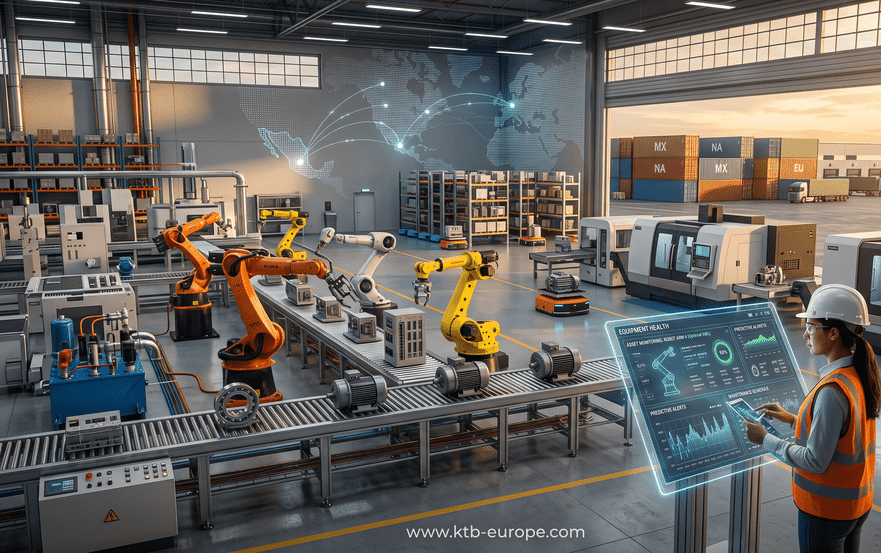
Ask any procurement manager supporting a modern production facility, and you'll hear a familiar story. The biggest interruptions don't always come from major equipment failures. They're often caused by a missing automation component, an unexpected maintenance requirement, or a sourcing process that can't keep up with production.
That is why Mexican MRO has become an increasingly important topic for manufacturers expanding operations in North America. In this context, MRO means Maintenance, Repair, and Operations for industrial manufacturing—not aircraft maintenance. It covers the products, planning, and procurement strategies that keep production lines running reliably.
For readers looking to learn more about mastering Mexican MRO procurement for nearshoring success, this detailed guide offers additional insight into today's sourcing strategies:
https://www.ktb-europe.com/en/blog/mastering-mexican-mro-procurement-the-key-to-nearshoring-success/
As manufacturing continues to move closer to major customer markets, maintenance procurement has become just as important as production planning. Companies that prepare for equipment needs before problems arise are often better positioned to maintain consistent operations.
Why Nearshoring Changes the Procurement Conversation
Nearshoring has encouraged many manufacturers to rethink how they organize production and sourcing.
Moving production facilities closer to key markets can improve responsiveness, but it also increases the need for dependable industrial support. Every automated production line depends on maintenance planning, replacement components, and reliable procurement processes.
Without those elements working together, production efficiency becomes harder to maintain.
Mexican MRO Is About More Than Replacement Parts
Industrial maintenance has changed significantly over the past decade.
Today's Mexican MRO strategies combine procurement planning, equipment reliability, industrial automation parts, maintenance coordination, and operational visibility into a single connected process.
Maintenance is no longer viewed as a separate department. It has become an essential part of manufacturing performance.
Vendor Sprawl Creates Everyday Procurement Challenges
Many facilities gradually build large supplier networks over time.
Different vendors may provide motors, bearings, sensors, electrical equipment, pneumatic systems, lubrication products, and other maintenance items. While this often happens naturally, it can create unnecessary purchasing complexity.
Managing many suppliers can make procurement slower, increase administrative work, and reduce visibility across maintenance operations.
Why Procurement Teams Focus on Vendor Consolidation
- Simplified supplier management
- Better purchasing visibility
- Improved coordination between maintenance and procurement
- Greater supply chain resilience
- Reduced administrative effort
- More consistent sourcing decisions
- Stronger operational planning
Consolidation is less about reducing supplier choice and more about improving procurement efficiency.
Predictive Maintenance Is Replacing Reactive Maintenance
Many manufacturers have moved beyond waiting for equipment to fail.
Predictive maintenance uses equipment data, connected sensors, and operational monitoring to identify developing issues before they interrupt production.
This allows maintenance teams to plan their work instead of responding to unexpected breakdowns.
Procurement benefits as well because purchasing decisions become more proactive and less reactive.
Benefits of Predictive Maintenance
- Earlier identification of equipment issues
- Improved maintenance scheduling
- Better coordination across departments
- Reduced manufacturing downtime
- More efficient indirect procurement planning
- Improved equipment reliability
When maintenance and procurement work together, production becomes more predictable.
Industrial Automation Parts Keep Modern Factories Moving
Manufacturing facilities rely on thousands of interconnected systems every day.
Programmable controllers, industrial sensors, drives, motors, robotics, and motion control equipment all require ongoing maintenance throughout their operating life.
Reliable access to industrial automation parts supports production continuity while helping maintenance teams complete planned work efficiently.
Indirect Procurement Deserves More Attention
Direct production materials often receive the most attention during procurement planning.
Yet indirect procurement supports every production line behind the scenes.
Maintenance supplies, repair components, automation equipment, tools, and operational materials all contribute to keeping facilities productive. Without an effective indirect procurement strategy, even highly automated factories can experience avoidable disruptions.
Multi-Brand Consolidation Supports Smarter Operations
Modern manufacturing rarely depends on equipment from a single manufacturer.
Production facilities often operate machinery from multiple brands, each requiring different maintenance components and sourcing relationships.
Managing these requirements through a coordinated procurement strategy helps simplify maintenance planning while reducing unnecessary purchasing complexity.
Characteristics of an Effective Mexican MRO Strategy
- Support for multi-brand industrial environments
- Strong indirect procurement processes
- Reliable sourcing of industrial automation parts
- Planning that supports predictive maintenance
- Better coordination between procurement and maintenance
- Focus on manufacturing downtime reduction
- Long-term supply chain resilience
These priorities help manufacturers build more consistent operations without increasing procurement complexity.
Building Resilient Manufacturing Operations
Supply chain resilience is developed through preparation rather than emergency response.
Organizations that strengthen procurement visibility, improve supplier coordination, support predictive maintenance, and simplify sourcing processes are generally better prepared for changing production demands.
An effective Mexican MRO strategy supports that objective by connecting maintenance planning with smarter procurement decisions.
Frequently Asked Questions
What does Mexican MRO mean?
Mexican MRO refers to Maintenance, Repair, and Operations within industrial manufacturing facilities in Mexico. It focuses on keeping machinery, production equipment, and industrial systems operating efficiently and should not be confused with aviation MRO.
Why is Mexican MRO becoming more important?
As manufacturing expands in Mexico, companies are placing greater emphasis on reliable maintenance planning, indirect procurement, industrial automation parts, and efficient sourcing strategies to support continuous production.
What is vendor sprawl?
Vendor sprawl occurs when organizations rely on a growing number of suppliers for similar maintenance categories. This can increase purchasing complexity and reduce procurement visibility.
How does predictive maintenance help manufacturers?
Predictive maintenance identifies developing equipment issues before failures occur. This allows maintenance teams to schedule repairs proactively while helping procurement teams prepare required components in advance.
Why is indirect procurement important?
Indirect procurement covers the products that support manufacturing operations, including maintenance supplies, repair components, industrial automation parts, and operational equipment. Effective management of these purchases contributes to more reliable production.
Conclusion
The discussion around Mexican MRO has evolved beyond sourcing replacement parts. Today's manufacturers are looking for procurement strategies that support operational continuity, simplify indirect purchasing, and improve coordination across maintenance and production teams.
Nearshoring has increased the importance of reliable maintenance planning, but long-term success depends on more than proximity. Organizations that reduce vendor sprawl, embrace predictive maintenance, strengthen supply chain resilience, and develop thoughtful sourcing strategies are better positioned to keep highly automated production lines operating efficiently as manufacturing continues to evolve.