A line goes down at 2 a.m. The maintenance technician diagnoses the fault in twenty minutes — a failed servo drive, a cracked gearbox housing, a fried I/O module. That part is often the easy problem to solve. The hard problem shows up an hour later, when purchasing pulls up the part number and finds out the OEM's lead time is eleven weeks, the local distributor doesn't stock it, and nobody documented whether an aftermarket equivalent was ever qualified.
This is the moment where maintenance and procurement stop being two separate departments and become one shared risk. And it's the moment that exposes how strong — or how thin — a plant's mro supply chain really is.
Why this keeps happening
Most plants don't have a sourcing problem in the abstract. They have a sourcing problem for a specific, narrow list of parts — usually the ones nobody thought to plan for, because on paper the equipment was reliable and the part rarely failed. That's exactly why it becomes a crisis when it does fail. Low-frequency failures get the least procurement attention and the least inventory priority, yet they're often tied to the components with the worst availability: legacy automation modules, motors built to a discontinued frame size, control components from a builder that's changed hands twice since the machine was commissioned.
Add to that a purchasing habit that's hard to break: treating unit price as the primary decision variable. A $400 component that takes ten weeks to arrive is not cheaper than a $650 component that arrives in four days if the line is down the whole time it's waiting. Most procurement teams know this intellectually. Fewer have built it into how they actually evaluate suppliers or set inventory priorities.
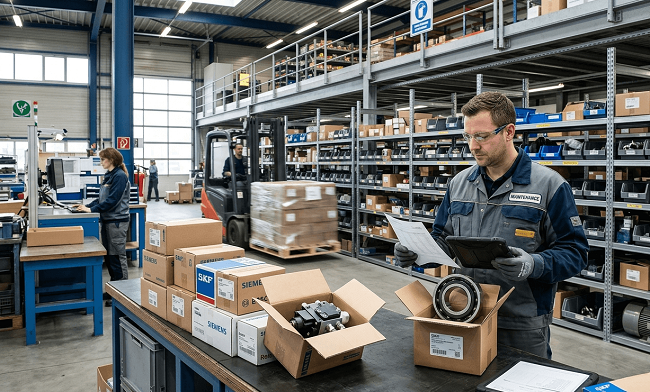
The automation failure that isn't really an automation failure
Here's a scenario that plays out in a lot of plants running mixed-vintage equipment. A line trips on a communication fault. Maintenance traces it to a network module on an older PLC rack — not a dramatic failure, just a component that's finally worn out after years of service. The technician can have the line running within the hour, except the module was discontinued by the manufacturer three product generations ago.
At that point, the maintenance problem is solved. What remains is entirely a procurement and sourcing problem: does an equivalent module exist from an approved secondary source, is there a compatible refurbished unit somewhere in circulation, or does the team have to consider an unplanned control system modification just to get production restarted. None of those are quick decisions to make cold, in the middle of a shutdown, with a plant manager standing at your desk asking for a timeline.
Where OEM sourcing stops being the automatic answer
Sticking with the original manufacturer feels like the safe choice, and for many components it still is — especially anything under warranty, anything tied to safety systems, or anything where documentation and firmware compatibility genuinely matter. But "safe" and "available" aren't the same thing, and OEM lead times on legacy components can run into months precisely because the manufacturer has deprioritized a part line that's approaching end-of-life.
An experienced procurement team treats the OEM-versus-alternative decision as a technical evaluation, not a cost shortcut. That means confirming exact specifications and tolerances, checking part-number history for superseded revisions, verifying documentation and certification requirements for the application, and understanding what happens to warranty coverage if a non-OEM component goes into a machine that's still under contract. A qualified aftermarket part, a legitimately sourced surplus unit, or a properly refurbished component can be the right call — but "right" has to be established before the emergency, not during it. Buying an unverified substitute under time pressure is how a four-day downtime event turns into a six-month reliability problem.
The inventory question nobody wants to own
Every plant has a version of this argument: should we stock a $300 part that fails once every four years? The instinctive answer is no — it ties up capital and clutters the storeroom. But the right question isn't how often the part fails. It's what happens to production when it does. A relatively cheap component that can stop an entire line for a week deserves a different inventory classification than a $5,000 part that's easy to get overnight from three different suppliers.
This is where maintenance and procurement genuinely need to sit down together, not exchange purchase requisitions. Maintenance knows which components have unpredictable failure patterns and which ones are tied to bottleneck equipment. Procurement knows which parts have volatile lead times, which suppliers are reliable under pressure, and which components are showing early signs of obsolescence — discontinued notices, shrinking distributor stock, price increases that usually precede a sunset announcement. Neither side has the full picture alone.
Supplier redundancy is a reliability decision, not just a purchasing one
Single-sourcing a critical component is a convenience that works fine right up until it doesn't. It's common to see a plant standardized on one distributor for a whole category of automation parts because pricing and account management were easy — until that distributor has an allocation issue, a factory delay, or simply doesn't carry the exact revision needed for an older installed base. Qualifying a second source for critical parts before you need one is unglamorous work. It also happens to be the difference between a same-week fix and a multi-week improvisation.
For plants dealing with international equipment or components no longer supported by domestic distribution, this is where broader sourcing networks matter. Working through a global sourcing partner rather than relying on a single regional distributor gives procurement more paths to a legitimate part, particularly for equipment built to European or Asian automation standards that US distributors don't always stock deeply. Teams evaluating a more resilient global MRO procurement approach tend to do it after a bad experience, not before — which is exactly backwards.
A workable decision process
None of this requires a major system overhaul. It requires a short list of habits:
- Flag components with single-source risk or known obsolescence, even if they haven't failed recently.
- Pre-qualify at least one alternative — aftermarket, refurbished, or secondary OEM channel — for anything on that list, before it's needed.
- Weight inventory priority by downtime exposure, not unit cost.
- Keep documentation (part numbers, revisions, technical specs, approved substitutes) in a place procurement can actually find during an emergency, not buried in a maintenance technician's notes.
- Review the critical spares list on a fixed schedule — obsolescence status changes quietly, and nobody notices until they're sourcing under pressure.
Conclusion
The teams that handle emergency sourcing well aren't the ones with the biggest storerooms. They're the ones who did the unglamorous work in advance — qualifying alternate suppliers, documenting compatible parts, and treating downtime exposure as a real cost rather than an afterthought. A resilient mro supply chain isn't built during a shutdown. It's built in the months before one, when there's still time to make a decision instead of just reacting to one.
FAQ
1. How do we decide which spare parts are worth stocking versus sourcing on demand?
Base it on downtime exposure, not purchase price. A low-cost part that can stop a bottleneck process for days deserves stock priority over a more expensive part that's easy to source quickly from multiple suppliers.
2. Is it ever acceptable to use an aftermarket part instead of OEM?
Yes, when it's been properly evaluated against specifications, documentation requirements, and the application's tolerance for risk. It shouldn't be a default cost-cutting move, but it also shouldn't be automatically ruled out, especially for legacy or discontinued components.
3. What's the biggest weakness in most plants' MRO supply chain?
Single-source dependency on parts that rarely fail. Because they're low-frequency, they get little attention until a failure exposes long lead times and no qualified backup supplier — which is exactly the kind of gap that a stronger mro supply chain is built to close.
4. How should maintenance and procurement share information more effectively?
Maintain a shared, accessible list of critical components with part numbers, known substitutes, and documented lead times. Review it on a set schedule rather than only updating it after a failure forces the conversation.
5. When does it make sense to look at international or secondary sourcing channels?
When domestic distribution for a specific part is thin, inconsistent, or tied to a single supplier — particularly common with older automation equipment or components built to non-US standards. Qualifying that channel before an emergency avoids scrambling during one.